June 01-04 • Berlin-Adlershof, Germany

Please keep in mind that the registration will close on May 15, 2026 (at 23:59 CEST).
Save the Date!
June 01-04, 2026, in Berlin.
The SUMO Conference, held every year in Berlin since 2013, is a must-attend event for anyone involved with SUMO. It gathers international participants from the industry, research and public institutions - to present (among others) projects, studies and advancements all around traffic, simulation and SUMO.
The conference offers opportunities to learn about new features, connect with other users, engage with the developers, exchange ideas, and even start new collaborations.
Ethics and Malpractice Statement
You can read our Publication Ethics and Publication Malpractice Statement, where we list the responsibilities of editors, reviewers, and authors.
Important Dates
For papers:
- ✅
Recommended title and abstract submission deadline: Sunday, January 11, 2026. - ✅
Paper submission deadline: Sunday, March 01, 2026. - Notification of acceptance/rejection: First week of April 2026.
- Camera-ready paper deadline: Sunday, May 10, 2026.
For posters:
- ✅
Mandatory title and abstract submission deadline: Sunday, March 01, 2026. - ✅
Notification of acceptance/rejection: Thursday, March 05, 2026. - Final poster upload deadline: Sunday, May 03, 2026.
For SUMO moments:
- ✅
Description submission deadline: Sunday, March 01, 2026. - Notification of acceptance/rejection: Monday, March 09, 2026.
Prices
- Regular Ticket: 575 EUR
- One-Day Ticket: 350 EUR
- Authors and Project Partners: 375 EUR
- Students & Invited Guests: 125 EUR (limited) *
All prices excluding VAT.
*Please contact us via email at sumo-conference@dlr.de to request a discount code for student registration. The availability is limited.
Registration
Registration is now open: https://sumo2026.welcome-manager.de/
Please keep in mind that the registration will close on May 15, 2026 (at 23:59 CEST).
Accommodation is not included within the registration fee and must be pre-booked separately.
Keynotes
Traffic simulation modeling: combining generative modeling with transportation science to achieve scalability

© Carolina Osorio
Prof. Dr. Carolina Osorio
Staff Research Scientist, Google ResearchFull Professor, HEC Montreal
Website
This talk presents physics-informed machine learning methods to search high-dimensional continuous spaces in a sample efficient way, with a focus on urban mobility applications. We discuss how the design of variance reduction methods for gradient estimation of generative models can accelerate convergence and robustify model training. We present how standard transportation science metrics can be used to perform physics-informed dimensionality reduction, enabling a more efficient search of high-dimensional spaces. We discuss recent advances in the use of macroscopic traffic models as metamodels for the design of digital urban mobility twins. Methods will be illustrated with case studies of various metropolitan areas. Finally, we identify research opportunities and challenges in the fields of simulation-based optimization and machine learning as applied to urban mobility problems.
About the Speaker
Osorio is a Full Professor at HEC Montreal, where Osorio holds the SCALE AI Research Chair in Artificial Intelligence for Urban Mobility and Logistics. Osorio is also a Staff Research Scientist at Google Research, where Osorio is research lead of Mobility AI. Prior to joining HEC Montreal, Osorio was a faculty at MIT for 9 years. Osorio has consulted for Alphabet's Sidewalk Labs, and has collaborated with top private and public sector, transportation and supply chain stakeholders, including Zipcar, Ford Motor Company, New York City Department of Transportation, and the San Diego planning agency SANDAG. Her research focuses on the design of ML and simulation-based optimization algorithms to tackle high-dimensional transportation problems. Osorio was recognized as an outstanding early-career engineer in the US by the National Academy of Engineering's EU-US Frontiers of Engineering Symposium, is the recipient of an MIT Technology Review EmTech Colombia TR35 Award and was on the GOOD 100 list of innovators in the category of "Minds That Are Hacking Our Surroundings for the Better". Since 2022, Osorio has been ranked yearly in the top 2% of the most cited scientists in the field of Operations Research, Transportation and Logistics.SUMO and I – 25 years later...

© DLR
Prof. Dr. Peter Wagner
Institute of Transportation SystemsGerman Aerospace Center (DLR)
Website
This contribution begins with a brief and biased account of the origins of SUMO. Given perceived current challenges in microscopic modelling, particularly with regard to the author‘s current favorite topic of traffic safety, it outlines potential future developments centered on modelling rather than usage.
About the Speaker
Being a physicists by training, I have worked in transport for over 30 years, focusing strongly on modelling and simulation. I started out working with cellular automata as traffic simulation tools, but I have also touched most of the pillars of the 4-step algorithm, i.e. on travel demand, traffic assignment, traffic signal control, and assessment (mostly emissions). Recently, I have developed a strong focus on traffic safety, which strongly resonates with modelling and a bit of simulation, but even more so with data analysis. While I have written some papers myself, I have done more work reviewing and improving the work of others, including the students of my classes at TU Berlin and elsewhere.Workshops
During the conference, a series of workshops will take place in dedicated rooms alongside the main program. These sessions offer participants the opportunity to engage more deeply with specific topics in a smaller, interactive setting.
Digital Twins and Traffic Management in Cities
This 2-hour workshop explores the potential of Digital Twins in urban traffic management. Participants will learn how real-time data integration and simulation models enable more adaptive, data-driven mobility systems. Interactive demonstrations highlight smart city case studies that use Digital Twins to optimise traffic flow, reduce environmental impact, and enhance safety. The session concludes with a discussion on technical challenges, scalability, and future directions within the SUMO ecosystem - defining practical next steps for intelligent urban mobility.
Navigating Complexity: Leveraging SUMO for Traffic Planning at Major Events
Large-scale events create complex interactions between vehicular traffic and pedestrian flows that require holistic planning tools. This workshop explores the added value of coupling SUMO with JuPedSim to simulate both road networks and crowd dynamics simultaneously. We will discuss specific needs, data requirements, and pitfalls faced by authorities, event organizers, and transport providers in this context. Through interactive discussion, participants will collaboratively define best practices for using multi-modal simulation in approval workflows and operational planning.
Simulating Connected and Automated Mobility
Connected and Automated Mobility (CAM) relies on advanced and interoperable simulation frameworks to evaluate communication, cooperation, and automated driving functions in realistic traffic scenarios. This workshop presents current developments and applications based on Eclipse MOSAIC, Eclipse SUMO, Eclipse ADORe, as well as specialized CAM use cases implemented with SUMO’s libtraci interface. Short impulse talks and live demonstrations by tool developers provide practical insights into architectures, coupling strategies, and communication modeling (e.g., CAMs/CPMs, platooning). The session is designed to stimulate exchange between developers and users and to discuss integration strategies and future directions for CAM simulation toolchains.
Social Event
⛴️ Boat Tour ⛴️
*Limited capacity
More info soon!
Language
The conference language is English.
Venue
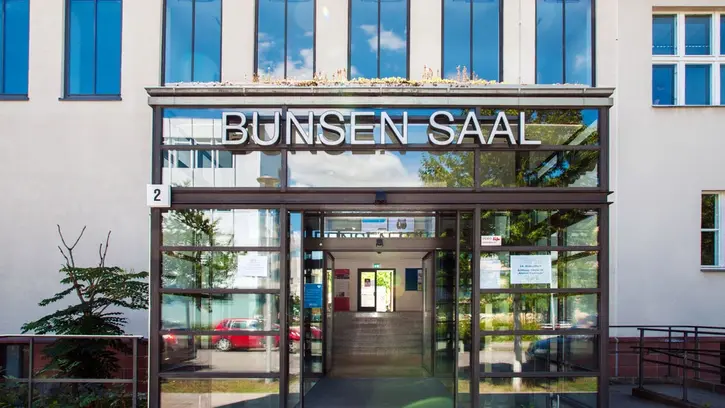
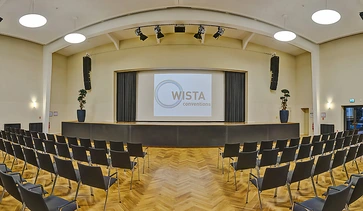
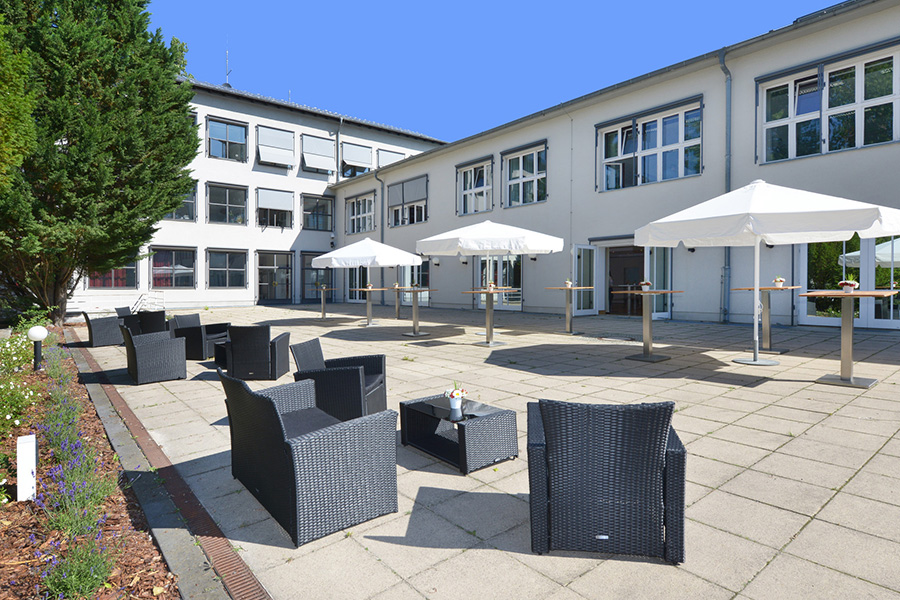
WISTA Event Center - “Bunsen-Saal” Website
Volmerstraße 2
12489 Berlin
Germany
Contact
For questions or comments, please contact the conference team at sumo-conference@dlr.de.